How Moissanite Is Made in a Lab — From Raw Crystal to Iced Out Hip Hop Jewelry

If you're dropping cash on a heavy iced out Cuban link or a custom pendant, you wanna know what's actually sitting in those prongs. "Moissanite" gets thrown around like a buzzword — some think it's glass, some think it's fake diamond. Truth? Natural moissanite (silicon carbide, SiC) is rarer than diamond and only found in meteorites. The stuff lighting up your S925 sterling silver hip hop chains is lab-grown — and the process is way more hardcore than most realize.
At GLEEI we source strictly VVS-grade lab created moissanite cut for maximum dispersion (fire). Here's the bench-level breakdown of how that stone goes from raw element to the icy drip on your neck.
What "Lab-Grown Moissanite" Actually Means — And Why It's Not CZ
First, clear the noise. Moissanite ≠ Cubic Zirconia (CZ). CZ is zirconium oxide — soft, cloudy within months. Moissanite is crystalline silicon carbide (SiC), a completely different mineral with higher refractive index, higher hardness, and double refraction that gives it that rainbow "ice" look hip hop heads love.
Lab-growing moissanite means replicating the extreme conditions SiC forms in — minus the meteor impact.
Step 1 — Growing the SiC Crystal Boule (The 2,000°C+ Process)
Natural SiC grows under insane heat & pressure. In the lab, manufacturers use one of two methods — the industry standard being Modified Lely (Sublimation Growth):
Graphite Crucible Setup: High-purity silicon and carbon powder are placed in a graphite crucible inside a sealed induction furnace.
Temperature Ramp: The chamber hits 2,300–2,500°C (4,200–4,500°F) under inert argon atmosphere — hot enough to sublimate SiC source material.
Seed Crystal Deposition: Vaporized SiC molecules deposit onto a seed crystal (usually hexagonal 6H-SiC polytype), slowly growing a single-crystal boule (cylindrical ingot) over 2–3 weeks.
Cool & Extract: Controlled cooling prevents internal stress fractures. The resulting boule is translucent greenish/yellowish before annealing.
Some suppliers skip annealing — unannealed stones can show color tint. GLEEI only uses fully annealed, color-graded (D-E-F colorless) moissanite to avoid the warm/greenish cast cheap stones sometimes show.
Step 2 — Slicing, Faceting & Precision Optical Alignment
The boule is:
Sawn into wafers with diamond wire saws
Pre-shaped into rough gem blanks ("pre-forms")
Cut & Polished on CNC faceting machines to standard brilliant cuts (round, baguette, cushion, etc.)
For hip hop jewelry — especially micro-pavé settings on Cuban links — the critical part is girdle thickness consistency and table-to-pavilion angle alignment. Misaligned facets kill the rainbow fire. GLEEI specs require ±0.05mm tolerance on melee (1.5–2.5mm stones) so they sit flush in shared-prong or pavé settings without gaps that catch lint or snag tees.
Step 3 — Grading VVS Moissanite for Hip Hop Jewelry Use
Unlike diamond's 4Cs, moissanite is graded on:
Attribute | GLEEI Spec | Notes |
Color | D–F (Colorless) | E/F preferred for white gold/rhodium plating |
Clarity Equivalent | VVS1–VVS2 | No visible inclusions under 10× loupe |
Cut Quality | Ideal / Excellent | Optimized for dispersion, not diamond brilliance |
Refractive Index | 2.65–2.69 (double ref.) | vs Diamond 2.42, CZ 2.15 |
Mohs Hardness | 9.25 | Second only to diamond (10); CZ is ~8.0 |
Dispersion ("Fire") | 0.104 | 2.4× diamond — that's the rainbow ice |
Stones that don't hit VVS clarity or show haze/orientation extinction are culled before setting.
Moissanite vs Diamond vs CZ — Hardness, Fire & Hip Hop Wear Reality
Property | Moissanite (Lab SiC) | Natural Diamond | Cubic Zirconia |
Mohs Hardness | 9.25 | 10 | ~8.0 |
Refractive Index | 2.65–2.69 (double) | 2.42 (single) | 2.15 |
Dispersion (Fire) | 0.104 | 0.044 | 0.060 |
Toughness | Excellent (survives daily wear) | Excellent | Poor (scratches/chips) |
Cloud Over Time? | No (stable SiC lattice) | No | Yes (surface degradation) |
Ethical / Conflict-Free? | Yes (lab grown) | Depends on source | Yes |
Bottom line: For daily-worn iced out hip hop jewelry, moissanite gives you better light performance than diamond under club/street lighting, won't cloud like CZ, and costs a fraction — provided you buy properly faceted, colorless VVS stock.
Why Lab-Grown Moissanite Is the King of Iced Out Jewelry
In the culture, "ice" is about presence, not geological pedigree. Lab-grown moissanite lets you flood a 12mm Cuban or a full-pavé Jesus piece without compromising on sparkle or durability. No blood mines. No $10K price tags. Just proper SiC science turned into street-level status.
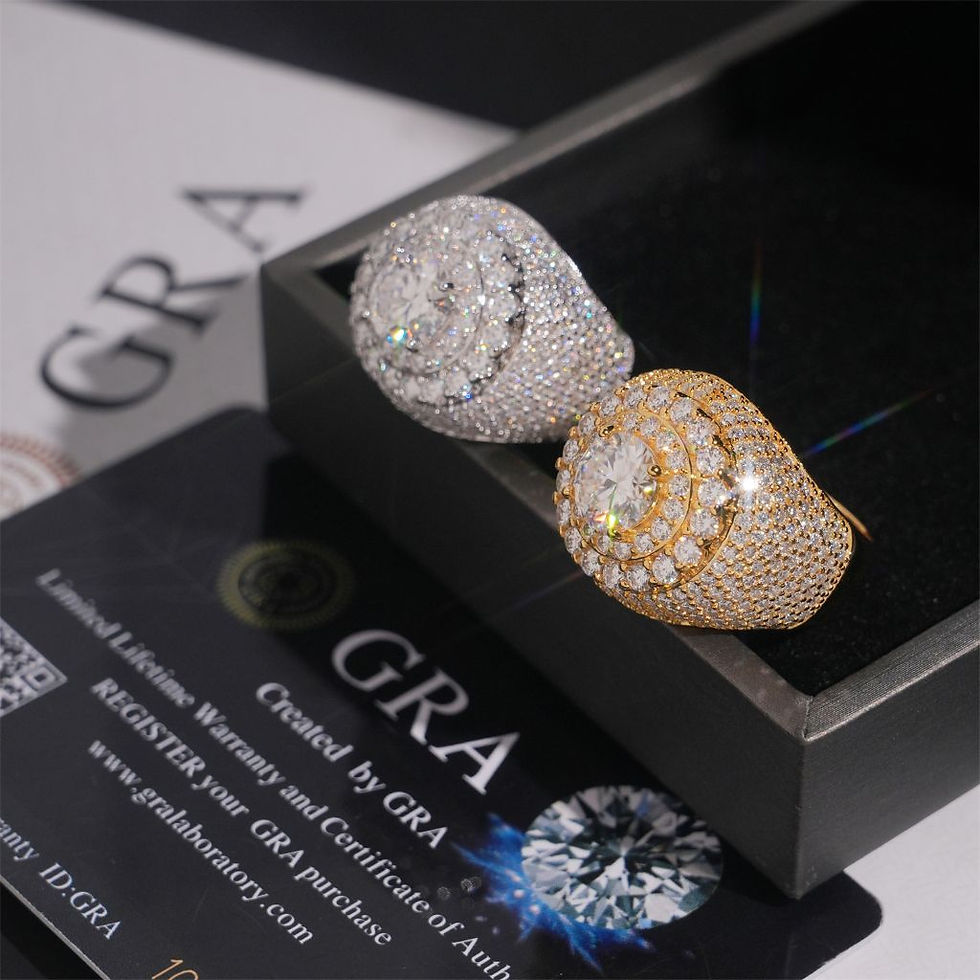
Every GLEEI moissanite Cuban link, ring & pendant uses hand-set VVS stones cut to ideal proportions — because your drip deserves more than foggy CZ or mystery glass.
FAQs — How Moissanite Is Made & Performs in Real Life
Q1: Is lab-created moissanite the same as natural moissanite?
A: Chemically and optically yes — both are silicon carbide (SiC). Natural moissanite is vanishingly rare and unsuitable for jewelry. All gem-quality moissanite on the market is lab-grown using the same SiC crystal growth method.
Q2: Will moissanite turn cloudy or scratch like CZ?
A: No. Moissanite ranks 9.25 on Mohs scale — second only to diamond — and its crystal lattice is stable. It will not cloud, yellow, or scratch under normal daily wear unlike CZ which degrades over 12–18 months.
Q3: Why does moissanite show rainbow colors instead of white sparkle like diamond?
A: Moissanite has higher dispersion (0.104 vs diamond's 0.044) and is doubly refractive. This creates stronger spectral "fire" — the rainbow ice effect — which is exactly why it's favored in iced out hip hop jewelry.
Q4: Is GLEEI's moissanite conflict-free?
A: Absolutely. All our VVS moissanite is lab-grown in ISO-certified facilities with zero association with mining or conflict regions.
Q5: Can moissanite be distinguished from diamond by eye?
A: Under normal daylight, high-grade colorless moissanite (D-F) looks very diamond-like. Under direct spotlight you may notice more rainbow fire — which in hip hop jewelry is considered a plus, not a flaw.


Comments