How Trash Cut Proportions Out You in Broad Daylight—Why Cheap Simulants Fail and VVS Moissanite Doesn't

You ever see a so-called "iced-out" ring on the 'Gram that looks like a disco ball under studio lights, then dead flat and grey in a sunny sidewalk pic? That's not the lighting—that's the cut. More specifically, it's garbage proportions on a cheap cubic zirconia (CZ) or low-grade synthetic spinel being pawned off as "Moissanite" or "diamond simulant."
In the Hip Hop jewelry game, cut is the difference between real drip and costume jewelry. You can plate brass in 5 microns of gold and it'll still look suspect if the stones are cut like marbles. At GLEEI we cut our VVS Moissanite to true Ideal Brilliant proportions—Tolkowsky-derived—optimized for SiC's higher refractive index (RI 2.65 vs diamond 2.42). Here's the shop-floor truth about why bad cut math betrays cheap stones the second sun hits 'em.
The Optical Math—What "Ideal Cut" Actually Means for Moissanite vs CZ
Round brilliant geometry was engineered for diamond's RI of 2.417. Moissanite (synthetic SiC) has a higher RI of ~2.648–2.691 and double refraction, meaning it can tolerate—and actually benefits from—slightly tweaked pavilion angles (typically 40.5°–41.0° pavilion, 34.0°–34.8° crown) to maximize Total Internal Reflection (TIR) without excessive "rainbow flare."
CZ has RI ≈ 2.15–2.18—lower than diamond. If you cut CZ on a diamond recipe, you already lose. If you cut it wrong(which mass-market $2/Ct CZ always is), you get:
Table too big (≥62%) → Light enters but can't bounce—excess white glare, zero fire.
Pavilion too shallow (<39°) → Light leaks out the girdle/side before reaching your eye = washed-out "fish-eye" effect in the center.
Pavilion too deep (>43.5°) → Light reflects once then exits through the opposite pavilion facet—shows up as a dark dead center / black hole (navel effect) under direct light.
Crown too low (<13%) or too steep (>38°) → Kills the dispersion spread; kills the contrast patterning.
Cheap CZ pavé stones in $30–$60 "iced" pieces are typically off-the-shelf pre-forms cut to save carat weight, not optics—table 65–70%, pavilion 37–38° shallow. They rely on hyper-saturated rainbow dispersion to distract in club light. Sunlight? They go dull, milky, or show a dark X through the table.
How a Bad Cut Exposes Fake Ice in Real-World Conditions
Three dead giveaways you'll spot on a poorly cut CZ or mis-cut simulant versus a properly proportioned VVS Moissanite:
1. Daylight "Flat & Dead" vs Sustained Fire
Under noon sun, a shallow-cut CZ washes out to near-translucent with a hazy white glow—light's escaping, not reflecting. Properly cut moissanite holds bright scintillation (white flashes) and dispersion (colored fire) because TIR is maintained even at wider angles. The stone looks alive, not asleep.
2. Fish-Eye or Black Center (Leakage Patterns)
Tilt a shallow pavilion CZ 15–20° toward you—you'll see a circular reflection of the girdle (fish-eye) in the table. Deep pavilion = dark center (navel). Neither happens on a well-cut moissanite observed from normal viewing distance because critical angle is respected.
3. Pavé Uniformity Test
On a legit iced-out Cuban link or signet ring, every micro-pavé stone should return similar brightness when rocked under a single light source. Cheap CZ batches have random proportion drift—some stones flash, some are black dots, some are dead white. That inconsistency is a fingerprint of bulk-molded, uncalibrated simulants.
Side-by-Side—Ideal VVS Moissanite vs Cheap CZ Cut Specs & Performance
Parameter | Ideal Round Brilliant Moissanite (GLEEI Spec) | Typical Cheap CZ Simulant (Costume "Ice") |
Refractive Index (RI) | 2.648–2.691 (birefringent) | ~2.15–2.18 (singly refractive) |
Table % | 53–57% (tight tolerance ±0.5%) | 60–70% (weight-retention cut) |
Crown Angle | 33.8°–35.0° | 30°–38° (uncontrolled) |
Pavilion Angle | 40.5°–41.0° (optimized for SiC TIR) | 37°–39° (shallow) or >43.5° (deep—blackout) |
Total Depth % | 59.0–61.5% | 56–65% (all over the map) |
Polish / Symmetry Grade | VG–EX (faceted, hand-checked) | Machine-tumbled, facet junctions soft |
Daylight Performance | Sustained brilliance + controlled fire | Washes pale / fish-eye / dark center |
Pavé Consistency (micro stones) | Calibrated mm-size, uniform return | Random—some dead, some hot, some grey |
Typical Cost (1Ct equiv) | $8–25 (true lab-grown SiC) | $0.10–0.50 (mass CZ) |
Data cross-referenced from Tolkowsky optical model (1919), AGTA moissanite cutting guidelines, and GIA CZ gemological profiles.
Why GLEEI Cuts Moissanite to Diamond-Proportion Standards—Not "Good Enough"
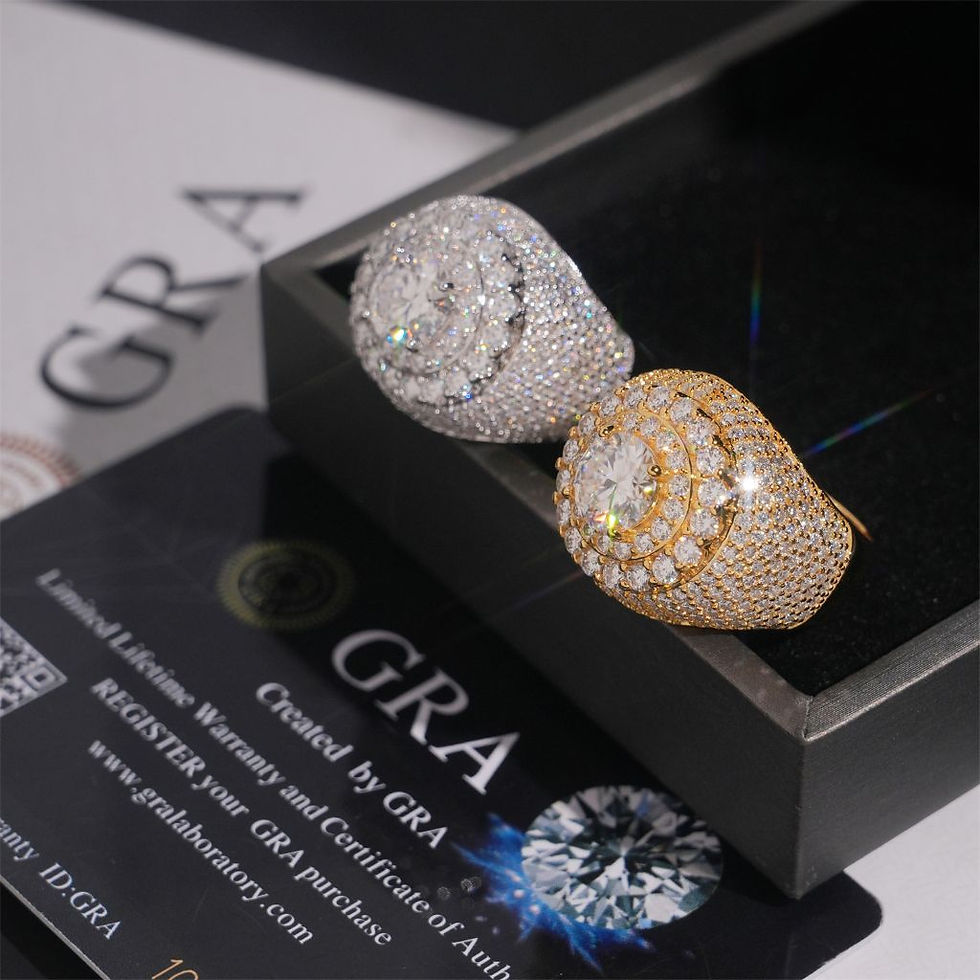
Most vendors selling "Moissanite" jewelry use off-the-shelf CZ pre-forms or old-school moissanite rough cut for max yield. We don't. Every VVS Moissanite in GLEEI's iced-out PRODUCT LINE—whether it's a 1.5mm micro-pavé on a Cuban Link Chain, a 6mm solitaire on a pendant, or a full-pavé signet pinky ring—is calibrated to:
Table 54–57% / Pavilion 40.8°±0.2° / Crown 34.5°±0.5°
Polish & Symmetry graded Very Good to Excellent
Girdle thickness controlled (thin–medium) to avoid hidden weight & dark shadowing on pavé edges
Optical match to S925 Sterling Silver mirror-finish bezels/prongs — white-metal backing amplifies return via specular reflection
Result: under club UV, golden hour, or harsh office fluorescents—your ice reads expensive. No dead spots. No chalky washout. No "oh that's obviously fake" moment in daylight selfies.
Quick Field Test—Spot a Bad-Cut Simulant Before You Buy
Tilt test: Hold the piece under a window. Tilt 20–30°. Ideal cut stays bright; shallow CZ shows fish-eye or goes dull.
Distance check: Step 3 ft back. Cheap CZ pavé often looks speckled (some stones black, some white). Quality moissanite pavé looks uniformly lit.
Flash photo check: Take a phone flash pic. Excessive, chaotic rainbow with zero white scintillation = typically deep-cut CZ or poorly faceted low-grade moissanite trying to overcompensate. Balanced white flashes + rainbow = proper cut.
FAQ
Q1: Can cubic zirconia (CZ) ever be cut to look like a well-cut diamond or moissanite?
A: Technically yes—if cut to shallower crown/adjusted pavilion for its lower RI (≈2.15) and sold as CZ—but virtually no mass-market "iced" jewelry does this. They use weight-saving proportions. The result is almost always light leakage and dead centers under daylight, which is why CZ iced-out pieces look cheap in real-world wear vs properly cut VVS Moissanite.
Q2: Does moissanite need a different cut than diamond because of its double refraction?
A: Yes. While many cutters use Tolkowsky's diamond angles as a baseline, optimal moissanite usually runs a slightly shallower crown (33.8–34.5°) and pavilion tuned to 40.6–41.0° to manage excess fire while maximizing TIR. Cutting it exactly like diamond can over-emphasize rainbow scatter; cutting it badly (like CZ) kills brightness entirely.
Q3: Will a bad cut affect the durability of the stone in a hip hop ring or bracelet?
A: Indirectly. Poorly proportioned stones often have thinner unsupported girdles or uneven facet junctions from rushed automated faceting—those areas chip easier when the piece gets knocked (which it will, on a daily-wear pinky ring or Cuban link). Well-cut, calibrated moissanite with proper girdle thickness resists edge chipping better.
Q4: How can I tell if an online seller is using real moissanite or passing off CZ as "Moissanite"?
A: Ask for the stone specs (RI ~2.65 double refraction confirmed by pen tester—moissanite pen beeps, CZ doesn't), check macro photos for facet sharpness, and do the tilt/ daylight test described above. GLEEI lists stone origin & cut standard openly and uses only lab-grown SiC VVS Moissanite.
Q5: Do fancy shapes (baguette, princess, emerald cut) on iced-out hip hop jewelry follow the same proportion rules?
A: They follow shape-specific depth/table windows (e.g. princess ideal depth 68–72%, table 60–68%; emerald depth 60–65%, table 57–65%), but the principle is identical—deviate too far = light leakage = dead ice. On GLEEI pieces, fancy cuts are calibrated to preserve step-cut mirror reflections (emerald) or crushed-ice scintillation (princess/pavé baguettes) per GIA/AGS guidelines adapted for SiC.


Comments