The 4Cs of Moissanite: Cut, Color, Clarity & Carat — How to Judge Real Iced Out Quality

Walking into the moissanite game, most people try to judge it exactly like diamond. Makes sense on paper — same 4C vocabulary gets tossed around. But here's the street-level truth from the bench: moissanite isn't diamond, and its 4Cs mean different things once you're setting it into a pavé-flooded Cuban link or a full-iced Jesus piece.
If you're buying a GLEEI VVS moissanite chain or pendant, you deserve to know what separates high-grade optical SiC from foggy CZ or window-glass junk. Let's break the 4Cs down the way they actually matter in hip hop jewelry.
Why the Diamond 4Cs Don't Fully Apply to Moissanite — And What Does
Moissanite is silicon carbide (SiC) — doubly refractive, higher dispersion (0.104 vs diamond 0.044), and grown in labs. It doesn't have the same inclusion genetics or color zoning as natural diamond. That said, jewelers still use the 4C framework to communicate quality — with hip hop–specific tweaks:
Cut = most critical (more than diamond, because fire is everything)
Color = look for D–F colorless (lower grades show green/yellow body tone)
Clarity = VVS equivalent minimum, though inclusions are rarer than in diamond
Carat = weight reference only; moissanite is ~10% lighter by volume
CUT — The Make-or-Break Factor for Iced Out Moissanite
In diamond world, cut affects brilliance. In moissanite, cut determines whether you get rainbow ice or a dead, dark stone. Badly proportioned moissanite shows "extinction" — goes dark from certain angles — which kills the drip under club lights.
Key specs GLEEI requires:
Ideal / Excellent cut per standard brilliant geometry (table 53–58%, crown angle 34–36.5°)
Girdle thickness consistent — critical for melee (1.0–2.5mm) going into shared-prong or micro-pavé
Polish & Symmetry: Very Good to Excellent
A poorly cut moissanite might be D color and flawless — and still look flat next to a properly faceted one. On a 12mm iced out Cuban link with 200+ stones, one bad-cut batch makes the whole piece look cheap.
Player note:If a vendor won't tell you the cut grade or facet alignment tolerance, they're not using jewelry-grade moissanite. Walk.
COLOR — Why D–F Colorless Matters on S925 Rhodium-Plated Jewelry
Unannealed or lower-grade SiC can show a faint greenish to yellowish body tone in certain lights — especially noticeable against white/rhodium-plated S925 sterling silver.
Moissanite Color Grade | Visual in Jewelry | GLEEI Verdict |
D–F (Colorless) | Clean white ice, no warm cast | ✅ Only grade we set |
G–H (Near Colorless) | Slight warmth; shows on white gold/plated silver | ❌ Not used — clashes with rhodium finish |
I–J+ / Unannealed | Visible green-yellow tint | ❌ Costume grade — reject |
For hip hop pieces meant to match white gold or platinum-toned stacks, D–F is non-negotiable. Yellow gold plating hides slight warmth better, but top-tier iced out work still sticks to DEF.
CLARITY — VVS1/VVS2 Equivalent Is the Floor for Hip Hop Melee
Lab-grown moissanite is inherently cleaner than most natural diamonds — you rarely see carbon spots. What you do see in low-grade production are:
Needle-like inclusions from incomplete crystal growth
Internal strain lines causing haze
Surface blemishes from poor polishing
GLEEI specs:
Clarity Equivalent: VVS1–VVS2 (loupe clean at 10×)
No eye-visible inclusions
No cloudiness under fiber-optic inspection
If a stone looks milky even slightly, it's a pass — milky moissanite kills the contrast that makes iced out settings pop.
CARAT — Moissanite Weight vs Visual Size (and Why It's Lighter than Diamond)
Moissanite's specific gravity is 3.21 g/cm³ vs diamond's 3.52. Result:
A 6.5mm round moissanite ≈ 0.88ct diamond equivalent weight (DEW) visually reads like a 1ct diamond.
Carat weight on certs is actual, not comparative — but buyers shop by mm diameter for matching settings.
Typical equivalency table (round brilliant):
Diameter | Moissanite Actual Wt | Diamond Equivalent Wt (DEW) |
4.0 mm | ~0.16 ct | ~0.25 ct |
5.0 mm | ~0.32 ct | ~0.50 ct |
6.5 mm | ~0.70 ct | ~1.00 ct |
8.0 mm | ~1.25 ct | ~2.00 ct |
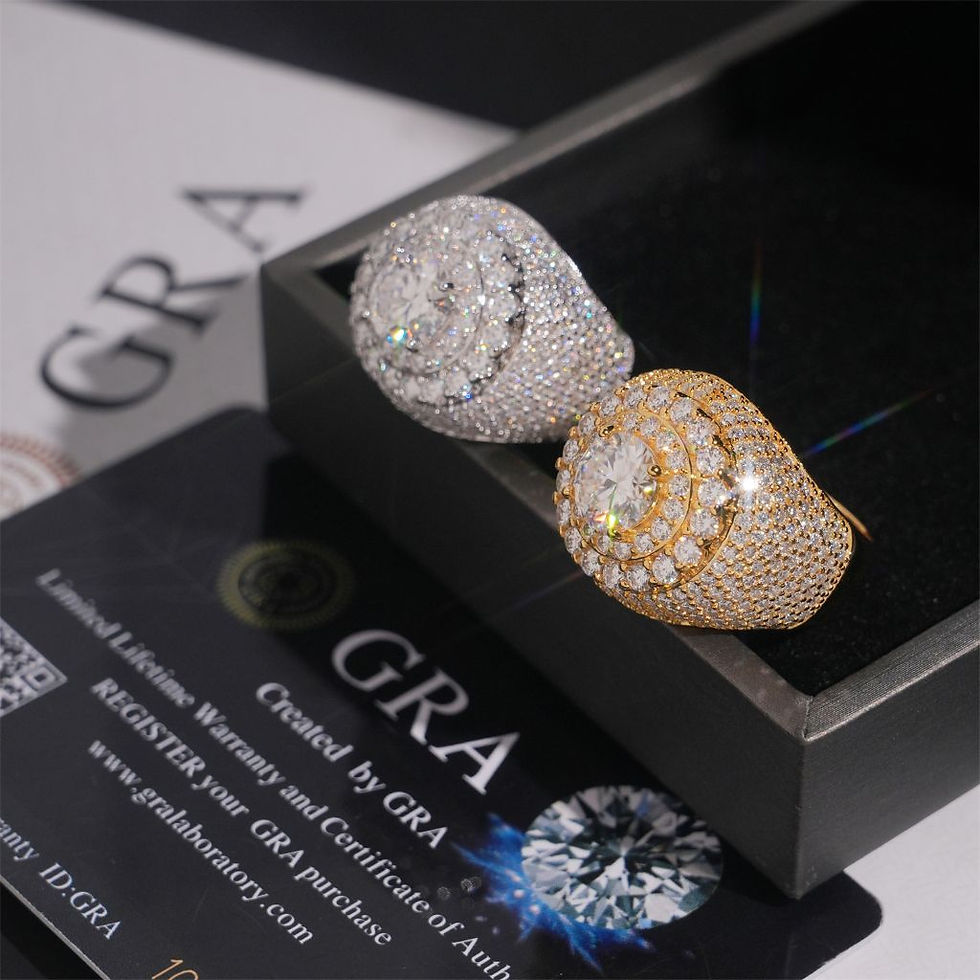
For custom pendants or signet rings, we size by mm, not carat — ensures proper fit in the casting and correct spread across the face.
GLEEI Moissanite 4Cs Spec Table — What We Accept vs Reject
4C | GLEEI Accepted Spec | Rejected |
Cut | Ideal/Excellent, ±0.05mm melee tolerance | Fair/Poor, misaligned facets, thick girdle |
Color | D–F Colorless, fully annealed | G+, unannealed (green tint) |
Clarity | VVS1–VVS2 equiv., loupe-clean, no haze | Included, hazy, internal strain visible |
Carat/Size | Sized by mm to design spec | Off-size affecting pavé spacing |
Every batch is spot-checked before setting into our S925 Sterling Silver Cuban links, pendants & rings.
FAQs — The 4Cs of Moissanite for Buyers
Q1: Does moissanite have the same 4Cs as diamond?
A: It uses the same terminology, but Cut is far more critical for fire, and Color grading must be stricter (D–F preferred). Clarity is generally higher due to lab growth, and Carat refers to actual weight — moissanite looks larger per carat than diamond.
Q2: What color moissanite should I buy for an iced out Cuban chain?
A: Stick with D–F colorless moissanite. Lower color grades can show greenish tint against rhodium-plated S925 silver, which kills the authentic ice look.
Q3: Is VVS clarity necessary if moissanite is already "clean"?
A: Yes — while most moissanite is clean, lower production batches can have internal strain or haze. Specifying VVS equivalent ensures optical clarity and maximum rainbow dispersion in pavé settings.
Q4: Will moissanite look bigger than a diamond of the same carat weight?
A: Yes. Because moissanite is less dense, a 1ct-equivalent moissanite is about 6.5mm (same visual spread as 1ct diamond), but actually weighs ~0.70ct. Always check millimeter size, not just carat, when ordering custom.
Q5: Can I use diamond 4C certificates to compare moissanite?
A: Not really. Most moissanite isn't GIA-graded like diamond. Reputable sellers provide moissanite-specific grading docs or batch test reports confirming color (D-F), clarity (VVS), and cut quality — that's what matters.


Comments