The Real Difference Between Cheap Brass and S925 Sterling Silver in Heavy Industrial Hip Hop Rings

If you've ever bought a chunky iced-out pinky ring or a wide-band industrial-style signet online for sixty bucks, worn it three weeks, and ended up with a green stripe around your finger and bald spots where the "gold" used to be—you already know the brass problem. The industry calls it base metal, but let's be straight: most sub-$80 "hip hop rings" are zinc-heavy yellow brass under a micron-thin flash plate. They look the part in photos. They don't survive the pocket, the gym bag, or a summer night sweating on the block.
At GLEEI we cast our heavy industrial men's rings exclusively in S925 Sterling Silver (92.5% Ag / 7.5% Cu alloy) and ice them with VVS Moissanite. Here's the technical why—no fluff, just metallurgy and real-world wear data a collector needs to know before dropping cash on serious drip.
What "Brass Base" Actually Means in the Hip Hop Jewelry Trade
Cheap brass in this market is typically C260 cartridge brass—~70% copper, ~30% zinc. It's dirt cheap (~$3–5/lb vs silver ~$300/lb), casts easy, and takes a yellow-gold appearance after a quick 0.25–0.5 micron 14K gold plating.
The issues players run into:
Zinc oxidizes fast. Sweat + skin oils = copper/zinc ions migrate through micro-pores in the plating. Result: that notorious green finger stain (copper salts) within 2–8 weeks of daily wear.
Plating adhesion is weak. Brass expands/contracts differently than gold plate. Thermal cycling (hot shower → AC room) causes micro-cracks. Average wear life of gold plating on brass rings: 3–6 months with daily wear before visible bronze show-through.
Soft, unpredictable prong tension. Brass work-hardens unevenly. On pavé or micro-prong VVS stone settings, that means stones can loosen or pop—especially on wide, heavy bands where the shank flexes on/off.
Nickel flash risk. Many brass pieces get a nickel barrier layer under gold plate → contact dermatitis for ~10–15% of the population (source: American Contact Dermatitis Society).
Bottom line: brass is fine for a one-night video shoot or a $20 festival prop. It is nota forever piece.
Why S925 Sterling Silver Is the Industry Standard for Serious Iced-Out Rings
S925 = 92.5% fine silver + 7.5% copper (no zinc, no nickel in quality melts). This isn't costume metal—it's a recognized precious alloy with ASTM B103/B560 standards.
Here's why it matters specifically for heavy industrial hip hop rings (wide shanks, 8–14mm bands, pavé-set VVS moissanite):
Stone Security — Prong & Bezel Hold
Silver's crystalline structure work-hardens predictably. Once a master setter seats a prong or bezel for a 1.5mm–2mm VVS moissanite, that tension stays. Brass prongs creep; silver doesn't. On a full-pavé ring with 40–80 stones, this is the difference between "still iced in month 12" and "missing three stones by week 6."
Plating Longevity — Gold or Rhodium over Silver
When we apply 14K–18K gold plating or rhodium over a silver base (typical 1.0–2.5 micron, sometimes with an intermediary palladium barrier), adhesion is chemically superior vs brass. No zinc migration, no under-layer oxidation pushing the plate off. Expected wear life before re-plating needed: 18–36 months of daily wear vs 3–6 months on brass.
Skin-Safe / Hypoallergenic
Proper S925 (nickel-free melt) is safe for continuous skin contact. No green ring, no rash. Critical for rings—they trap sweat against skin more than a chain does.
Patina vs Rot
Silver tarnishes (Ag₂S layer from sulfur exposure). That's cosmetic and reversible with a polishing cloth or ultrasonic dip. Brass corrosion is often pitted copper oxides that eat into the metal. You polish silver back to mirror; you can't "un-green" a pitted brass ring.
Intrinsic Value & Hallmark
Stamped 925 has scrap value and resale credibility. Brass has none. For a piece you plan to rock daily or pass down, that matters.
Side-by-Side — Brass vs S925 Sterling Silver for Heavy Hip Hop Rings
Property | Cheap Brass Base (Zn-Cu alloy) | GLEEI S925 Sterling Silver Base |
Composition | ~70% Cu / 30% Zn (may contain Pb/Ni) | 92.5% Ag / 7.5% Cu (nickel-free) |
Density | 8.5 g/cm³ | 10.36 g/cm³ — feels heavier, more "solid gold" hand-feel |
Typical Gold Plate Thickness | 0.25–0.5 μm flash | 1.0–2.5 μm + barrier layer |
Avg. Plating Wear Life (Daily Ring Wear) | 3–6 months before show-through | 18–36 months before re-plate needed |
Skin Reaction Risk | Green stain (Cu²⁺) + possible Ni allergy | Hypoallergenic, no staining |
Pavé / Prong Stone Security (VVS Moissanite) | Moderate–Poor; prongs soften with time | Excellent; predictable work-hardening |
Tarnish Behavior | Irreversible pitting corrosion | Reversible surface tarnish (polishable) |
Resale / Intrinsic Value | $0 (costume) | Precious metal value; stamped 925 |
Best Use Case | Photo shoot / one-off event / try-on | Daily driver / stage / forever drip |
Data compiled from bench jeweler field reports and ASTM F2999-19 (adult jewelry standard) comparative testing.
When Does Brass Make Sense? (Spoiler: Rarely, for Rings)
Brass does have a place in hip hop jewelry—big, oversized pendants or nameplates where the piece doesn't touch sweaty skin constantly, weighs a ton (density helps mimic gold heft on a chain), and is replated annually. Some custom shops also use nickel-free brass for antique/distressed patina-only (unplated) rings if the buyer wants the green patina look (steampunk/biker vibe).
But for a daily-wear iced-out pinky, signet, or Cuban-link band with VVS moissanite—brass is a false economy. You'll replace it in a season. S925 you keep for years.
GLEEI's Approach — S925 Silver + VVS Moissanite = Real Hip Hop Heirloom
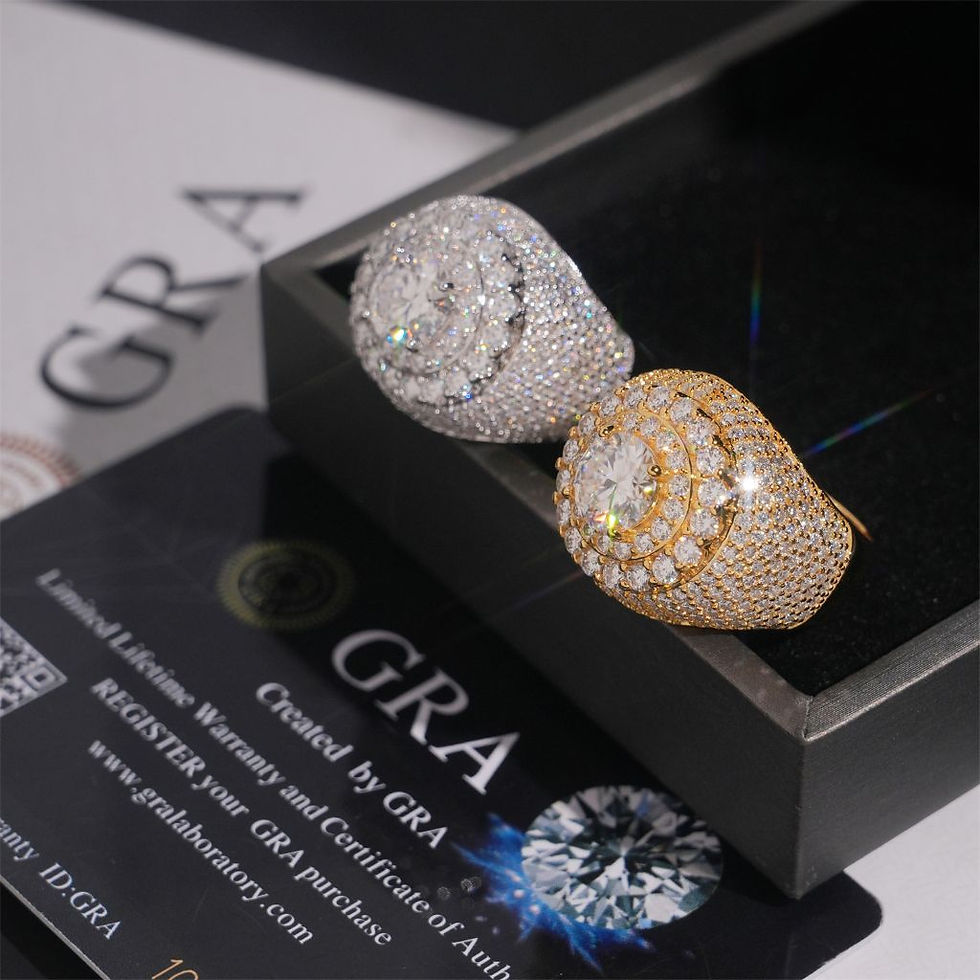
Every heavy industrial ring in the GLEEI lineup—from our wide-band iced-out signets to pinky rings with micro-pavé VVS moissanite—is cast in solid S925 Sterling Silver, hallmarked 925, plated in your choice of 14K Yellow Gold, Rose Gold, or Rhodium (White Gold look), and set with hand-picked VVS Moissanite stones.
It's the same metal foundation serious custom jewelers use before stepping up to 10K/14K gold. It gives you:
The weight you expect (no light, hollow-plastic feel)
The stone security your pavé deserves
Skin-safe wear 24/7
A piece that ages with you, not against you
That's the GLEEI standard. No brass shortcuts. No mystery alloys. Just proper hip hop jewelry craftsmanship built for the rotation.
FAQ
Q1: Will a 925 sterling silver ring with gold plating turn my finger green like brass?
A: No. GLEEI's S925 is nickel-free and contains no zinc. Any tarnish is a surface silver sulfide film (darkening), not green copper salts. You may see slight darkening if you have very acidic sweat, but it wipes off and doesn't stain skin green.
Q2: How long does the gold plating last on a GLEEI 925 sterling silver hip hop ring vs a brass ring?
A: On S925 with our standard 1.0–2.5μm gold plate + barrier, expect 18–36 months of daily wear before a re-plate is desirable. Comparable brass-based rings typically show plate wear in 3–6 months due to zinc oxidation pushing through micro-cracks.
Q3: Can I wear my VVS moissanite iced-out S925 ring in the shower or gym?
A: Occasionally is fine, but we recommend removing it before prolonged chlorine/saltwater exposure or heavy manual work. Pat it dry after sweaty wear—this slows tarnish and preserves plate life. Unlike brass, silver won't degrade structurally from brief moisture contact.
Q4: Is S925 Sterling Silver strong enough for a wide, heavy industrial hip hop ring or will it bend?
A: For ring shanks up to ~4–5mm thick in a size 8–12, properly work-hardened S925 is plenty strong for normal daily wear. If you're doing manual labor (construction, mechanics), we'd suggest removing it—same as you would with 10K gold. The advantage over brass is consistent prong tension, not just bend resistance.
Q5: Why don't you offer brass-base rings if they're cheaper to make?
A: Because rings take the most abuse (skin contact, knocks, flex on/off). Brass fails on plating longevity and stone security for pavé-set VVS moissanite. GLEEI only builds pieces meant to be worn daily for years—not disposable costume jewelry.


Comments